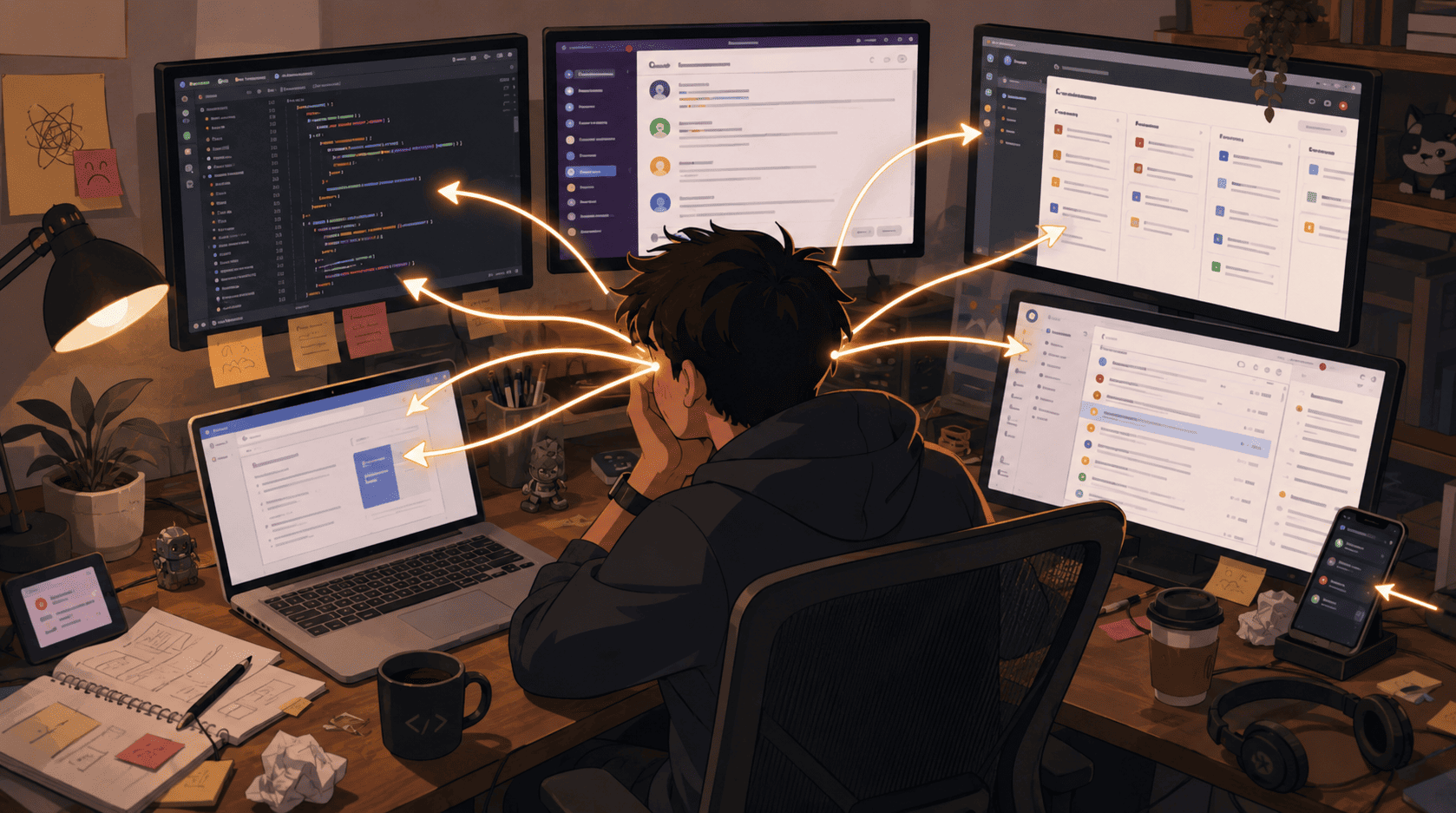
The Real Cost of Context Switching as a Developer
You know that feeling when you close your laptop at the end of the day, you are tired, but you are not sure what you actually finished? Let me describe a day that might look familiar.
You sit down in the morning with a clear plan. Finish that API integration you have been putting off. Fix a reported bug on the dashboard after lunch. Then review a pull request from another contributor before the day ends. Three things. Reasonable. But here is what actually happens.
9:00 AM - You open your code editor. You see a message about a bug in your project. Not critical, but your brain goes there anyway.
9:15 AM - You jump to check the logs. While waiting, you open the PR to “just skim it.”
9:30 AM - You notice a typo in the PR comment. You reply. The author responds. A small back-and-forth starts.
10:00 AM - You go back to your API code. You cannot remember where you were. You scroll the file. Scroll again. Close it. Open the dashboard bug instead.
10:30 AM - A message pops up: “Hey, can you look at this quickly?” You look at it. You look away from your own code.
Noon - Lunch. But your brain is still spinning. Not really eating. Not really resting.
2:00 PM - Back to work. You have four tabs open. The API file. The dashboard bug. The PR. The logs. None of them get more than 5 minutes of focus.
5:00 PM - You check the time. Almost the whole day gone. You tell yourself you will push through tonight. You don’t.
7:00 PM - You close your laptop. You did not finish the API integration. You did not fix the bug. You did not approve the PR. Your git log for the day? One commit: “WIP.”
Just… WIP.
If this sounds like your average Saturday, you are not alone. I have been there too. More times than I want to admit.
The Real Cost Is Not What You Think
I used to think I was good at multitasking. I was wrong. What I called “multitasking” was actually rapid switching between unfinished things. My brain was not doing multiple things at once. It was abandoning one task, starting another, abandoning that, then panicking and trying to do everything.
Look, every time you switch context, you pay a cost. Your brain has to reload the problem. Remember where you left off. Rebuild the mental model. And the thing people don’t talk about enough is: the switch cost is not linear. It compounds.
When you switch once, you lose maybe 10 or 15 minutes. Not a big deal. But ten switches in a day? You are not losing 150 minutes. You are losing the depth of your thinking. Shallow work on five things is worse than deep work on one thing that matters.
I did not fail on Saturday because I was lazy. I failed because I let my attention get pulled in five directions. And the worst part? Every switch made me feel busy. But at the end of the day, nothing real to show. This reminds me of something I wrote before. The idea of productive procrastination. Staying busy with the wrong things. Context switching feeds that. It makes you feel active while you are stuck.
Three Things That Helped Me
I will not pretend I fixed everything. I still have bad days. But three things made a real difference.
1. The morning block is sacred
First 2 hours of my day? No message. No email. No “quick look” at anything. Just the one thing I decided the day before. I write it in a text file and leave it open on my second monitor. One sentence. “Today I finish the API pagination logic.” That is all. If something urgent comes up during this block, I ask myself: can this wait 2 hours? The answer is almost always yes.
2. I track switches, not hours
I used to track how many hours I worked. Now I track how many context switches I made. By the end of the day, I ask myself one question: “How many times did I stop one thing and start another?” My target is less than 3 per work session. If I hit more than 5, I know tomorrow will be a cleanup day. Fixing bugs I made while switching too fast.
3. Write down where you stop
This one changed everything for me. Before I stop working on something. Lunch break, a friend calls, end of day. I write a note. Could be just a sentence. “Next: the validation function needs to handle empty inputs. I was about to add an if-check after line 42.” Sounds small. But when I come back, I do not waste time figuring out where I was. I just read the note and continue. The switch cost drops from 15 minutes to maybe 2.
Why This Matters More Now
We have more tools. More chat apps. More notifications. More AI assistants promising to make us faster. But more speed does not help if you are running in the wrong direction. I am still learning this one.
AI tools are great. I use them every day. But they don’t solve the context switching problem. If anything, they make it worse. Now when I switch to check a message, AI helps me write a quick reply. But I still lost my flow. The AI didn’t lose it. I did. The real power is not speed. It is doing fewer things without interruption.
A Question
I spent a long time feeling guilty about unproductive days. Thinking I needed more discipline. More willpower. Better time management. But the problem was not me. It was the environment I let happen around me.
So let me ask you: what is the one distraction you keep letting in, even though you know it kills your focus? For me, it is notifications and the habit of “just checking” things. For you it might be something else. But once you name it, you can protect yourself from it. Not by being stronger. By being smarter about where you put your attention.
See you in the next post.